Sleep Tracking for Men: Which Metrics Actually Matter
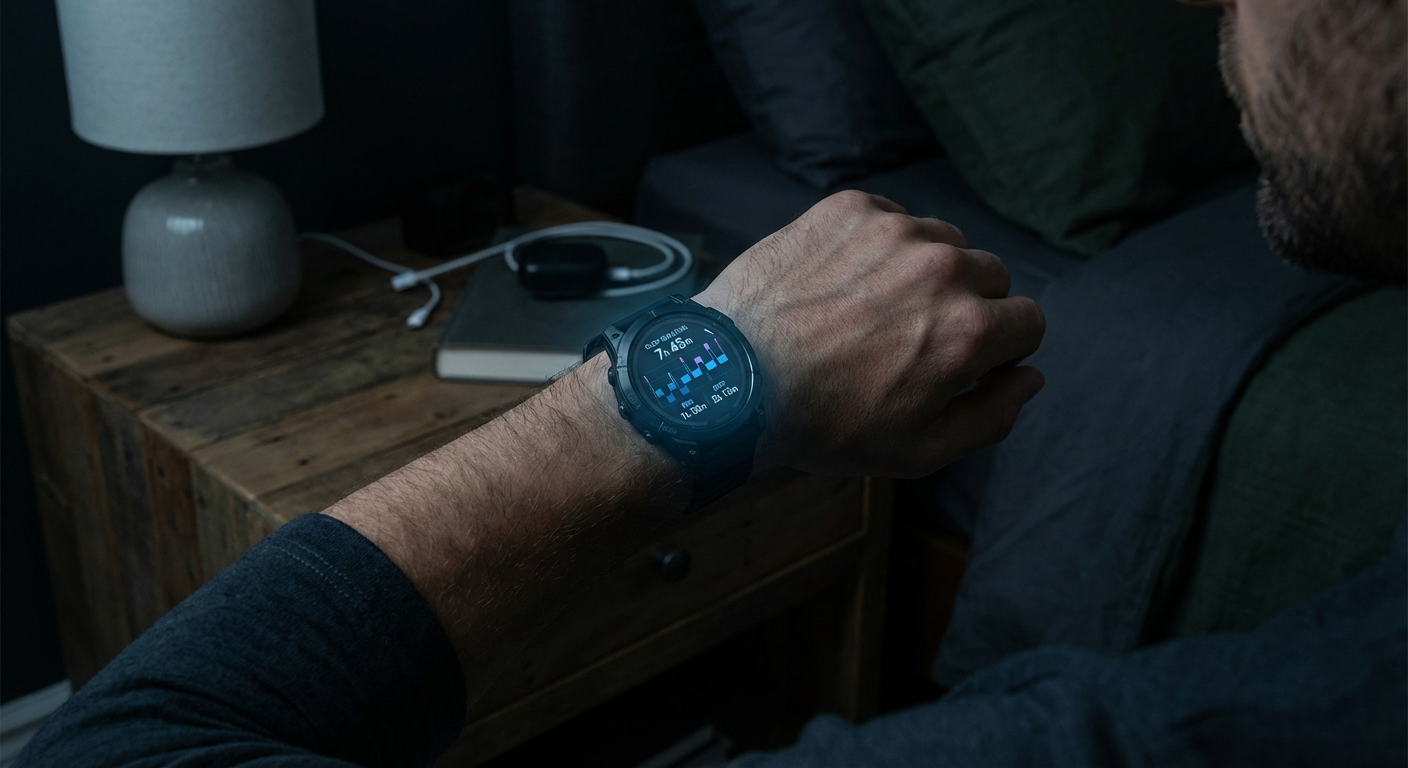
Optimizing your sleep is the highest-leverage move a trainee can make for muscle protein synthesis and cognitive performance. While most men obsess over total hours, specific biomarkers like HRV, deep sleep percentage, and sleep efficiency offer a more accurate blueprint of physiological recovery. Understanding which metrics to track—and which to ignore—is essential for long-term health and peak performance.
Why Does Deep Sleep Percentage Impact Growth Hormone?
For men who train, deep sleep (Slow Wave Sleep) is the holy grail of recovery. During this stage, the body prioritizes physical restoration. This is specifically when the pituitary gland releases the majority of its daily pulse of Human Growth Hormone (HGH). HGH is essential for tissue repair, muscle growth, and fat metabolism. If your deep sleep is cut short, your recovery window shrinks, regardless of how much protein you consume.
Research indicates that the timing of this sleep stage is often more critical than the total duration. Growth hormone secretion is heavily front-loaded in the first half of the night during the initial deep sleep cycles. Frequent caffeine use or late-night alcohol consumption can fragment these cycles, leading to lower HGH output even if you remain in bed for eight hours. (Dijk, Journal of Physiology, 2012)
What Is the Difference Between Sleep Efficiency and Total Time?
Many men make the mistake of conflating "time in bed" with "time asleep." This is where sleep efficiency becomes the primary metric to watch. Sleep efficiency is the percentage of time spent actually sleeping while in bed. A high-performing man should aim for an efficiency of 85% or higher. If you are in bed for nine hours but only sleeping for seven, your efficiency is roughly 77%, which suggests underlying issues like insomnia or environmental disturbances.
Focusing solely on total sleep time can lead to a false sense of security. You might clock eight hours, but if that sleep is poor quality and highly fragmented, your nervous system remains in a state of low-level stress. Prioritizing efficiency ensures that the time you invest in bed actually translates to physiological recovery. To help identify your specific efficiency blockers, you can take our free sleep assessment.
How Does HRV Serve as a Proxy for Recovery?
Heart Rate Variability (HRV) is perhaps the most powerful tool in a lifter's arsenal. HRV measures the variation in time between each heartbeat, serving as a direct window into your autonomic nervous system. A high HRV indicates that your parasympathetic nervous system (rest and digest) is dominant, meaning you have recovered from the previous day's stressors. Conversely, a low HRV suggests that your sympathetic nervous system (fight or flight) is still in the driver's seat.
Studies have shown that using HRV to guide training intensity can lead to better strength gains compared to following a static program. When your HRV is suppressed, it is often a sign of systemic fatigue or impending illness. (Herzig, Frontiers in Physiology, 2017) Using this metric allows you to decide whether to push for a new personal record or take a "deload" day. For those looking to support their nervous system's ability to downshift, exploring the formula page can provide insights into key micronutrients like magnesium and L-theanine.
Why Is REM Percentage Critical for Cognitive Recovery?
While deep sleep handles the physical side of the equation, REM (Rapid Eye Movement) sleep manages the mental side. This is when the brain processes emotions, consolidates memories, and clears out metabolic waste. For men in high-stress careers or those learning complex athletic movements, REM sleep is non-negotiable. It is the period where "procedural memory" is locked in, meaning the technical cues you practiced in the squat rack are hardwired during this stage.
REM sleep typically increases in duration during the second half of the night. If you habitually wake up early for a 5:00 AM workout, you are likely cutting off your longest REM cycles. This can lead to brain fog, irritability, and decreased reaction times. Balancing the need for early training with the necessity of REM sleep is a common challenge for many in our community. Using a supplement like DOZE can help you reach these restorative stages more quickly after a stressful day.
Why Does Sleep Onset Latency Actually Matter?
Sleep Onset Latency (SOL) is the amount of time it takes you to fall asleep once the lights go out. A healthy SOL is typically between 10 and 20 minutes. If you fall asleep the second your head hits the pillow, it is actually a sign of severe sleep deprivation rather than "being a good sleeper." On the flip side, if it takes more than 30 minutes to drift off, your mind is likely too wired for rest.
Tracking SOL helps you identify if your "wind-down" routine is effective. Factors like blue light exposure, late-night meals, and high-intensity evening training can all artificially extend your latency. If your SOL is consistently high, it suggests a mismatch between your circadian rhythm and your lifestyle habits, which can ultimately lead to chronic cortisol elevation. (Lack, Sleep Medicine Reviews, 2008)
What Are the Limitations of Consumer Wearables?
It is important to remember that most consumer-grade rings and watches are not medical devices. While they are excellent for tracking trends, they often struggle with "stage transition" accuracy. For instance, many devices have difficulty distinguishing between quiet wakefulness and light sleep, which can lead to skewed data regarding your actual sleep stages. (de Zambotti, Sleep, 2019)
Despite these limitations, the "direction of travel" in your data is what matters. If your watch shows a 20% drop in deep sleep over a week, you don't need to worry about the exact minute count: you simply need to recognize that your body is signaling a need for better recovery. Use these devices as compasses rather than precision scales. Obsessing over the exact percentage of REM every single morning can actually induce "orthosomnia," a condition where the stress of trying to get perfect sleep data actually ruins your sleep quality.
What Should You Track Weekly Versus Nightly?
Nightly obsession leads to anxiety: weekly tracking leads to progress. On a nightly basis, it is helpful to check your HRV and Sleep Onset Latency to adjust your daily training intensity. If your HRV is in the red, perhaps you swap the heavy deadlifts for a zone 2 cardio session. If your latency was high, you might need to dim the lights 30 minutes earlier the following night.
On a weekly basis (and monthly basis), look at your Deep Sleep and REM percentages. Are they trending up or down? This is where you can see the impact of lifestyle changes, such as cutting out caffeine after noon or implementing a supplement protocol. Long-term trends are far more indicative of your overall health and hormonal status than any single night of data. Consistency in these metrics is what builds a foundation for long-term muscle retention and cognitive sharpness. (Grandner, Sleep Medicine Clinics, 2017)
Ready to Optimize Your Recovery?
Data is only useful if you act on it. If your tracking shows that you’re struggling with sleep efficiency or falling short on deep sleep, it’s time to take a systematic approach to your evening routine. Start by taking our free sleep assessment to identify your specific recovery gaps and see how our targeted formula, DOZE, can help you lock in the metrics that actually matter for your performance.